

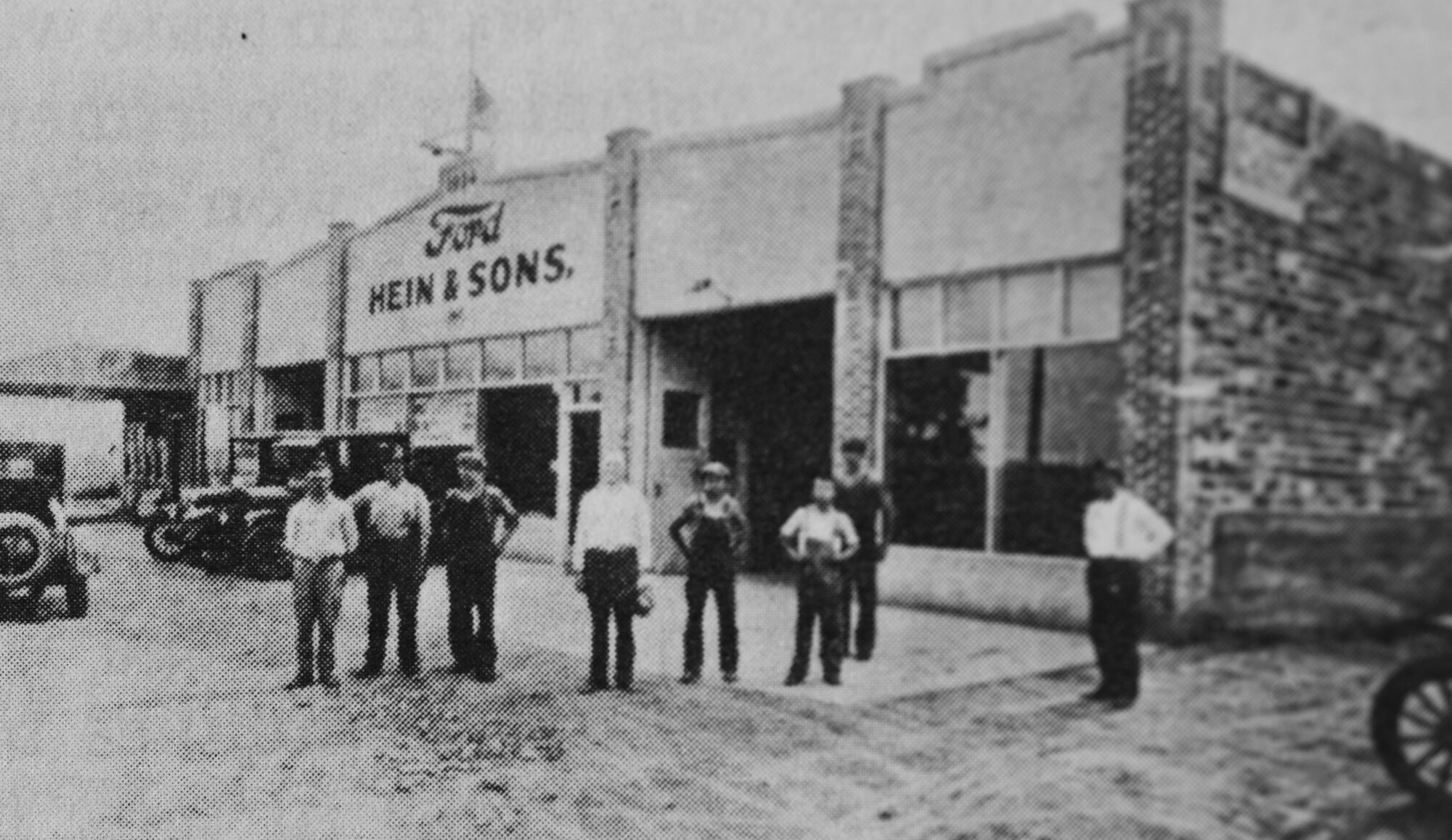
The Hein & Son Ford Garage was started by R.A. “Albert” Hein in August 1919 along W. Baseline Road after he purchased the former Lafayette Sales Company. Hein moved the dealership and repair garage to a new brick and stucco building at 607 S. Public Road constructed by Longmont contractor Oscar C. Herdener. Construction on new Hein & Son Ford Garage started in March 1924 with completion in May 1924.
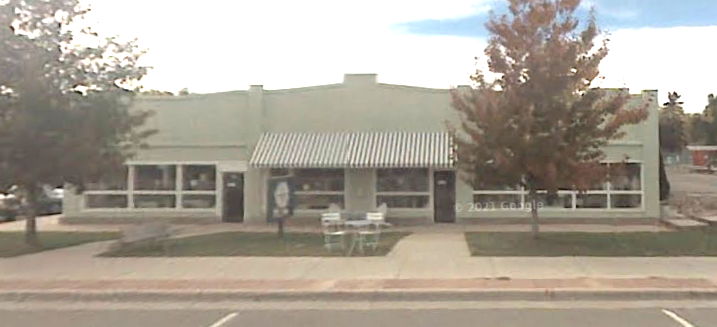
Hein & Son Ford Garage and the former Lafayette Sales Company were the only Ford dealerships in Lafayette history. The Chevrolet dealership, McMahon Chevrolet, occupied the 300 block of N. Public Road for decades.
Built using structural brick and hollow clay tile, but now completely covered with stucco, the architecture of 607 S. Public Road exhibits Classical Revival with Art Deco elements. Prominent Classical Revival features include symmetrical design, a low parapet wall around the roof and square brick columns that define the corners and entryways. The tiered, angled false front parapet is more indicative of Art Deco styles.
The Kimbark side of the Hein building, the south elevation, also has a tiered parapet and was the Ford car lot side of the building, with the garage entries and showroom facing the east and fronting S. Public Road. From a circa 1926 photograph of the building, the front elevation columns on the Public Road side appear to be made of conventional brick with a stucco infill visible at the top third of the facade. The side walls of the building are hollow clay tile manufactured in Longmont.
The former Hein & Son Ford is the second largest historical brick building in Lafayette, with the former Lafayette High School — now Pioneer Elementary school — being the largest. In general, prior to the 1950s brick was not the preferred building material due to Old Town’s expansive soils and undermined building lots. In 1924, putting up a brick building was considered risky — in 1916 locals had witnessed the first Lafayette school, a two-story brick building built in the 1890s, literally crumble into pieces due to coal mine subsidence.
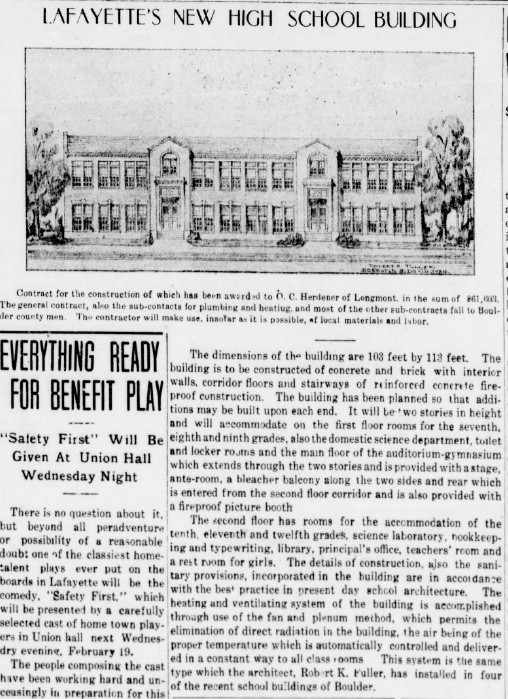
In 1925 O.C. Herdener also built Lafayette’s most prominent Classical Revival building, the Lafayette High School building. A locally landmarked structure, the Lafayette High School/Pioneer Elementary building at 101 E. Baseline Road was designed by prominent architect Robert K. Fuller. The structure has symmetrical design, brick exterior and low parapet walls that define the roof line.
Herdener was paid $61,000 to build the Lafayette school. Herdener also built a dozen or more schools and auto dealerships from 1923 to 1927. He completed Wellington High School, also a Classical Revival building, in Jan. 1926.
For unknown reasons, the 500 and 600 blocks of S. Public Road were excluded from the Lafayette Public Road Intensive Survey dated May 2011 and conducted by Bunyak Research Associates. Properties excluded from that study included the historically significant mid-century motor court at 509 S. Public Road, the Post Office at 603 S. Public Road, the Banecks Grocery Store at 610 S. Public Road and the former Hein & Sons Ford Garage at 607-611 S. Public Road, recently known as retailer Elizabeth’s Embellishments.
With the exception of the Post Office, these buildings exemplified a shift in commerce in the early 1920s from the E. Simpson Street corridor to auto-related commerce on the Public Road corridor known as the Lincoln Highway. Gas stations, auto dealerships, repair garages, restaurants and motor inns catered to a very busy state highway carrying tourist traffic to Rocky Mountain National Park from Denver. The construction of the Boulder-Denver Turnpike in 1952, and of the Interstate system east of Lafayette, decreased automobile traffic to the extent that most of the motor courts were converted to apartments.
Keller Truck and Implement occupied the former Hein Garage from 1938 to 1963.
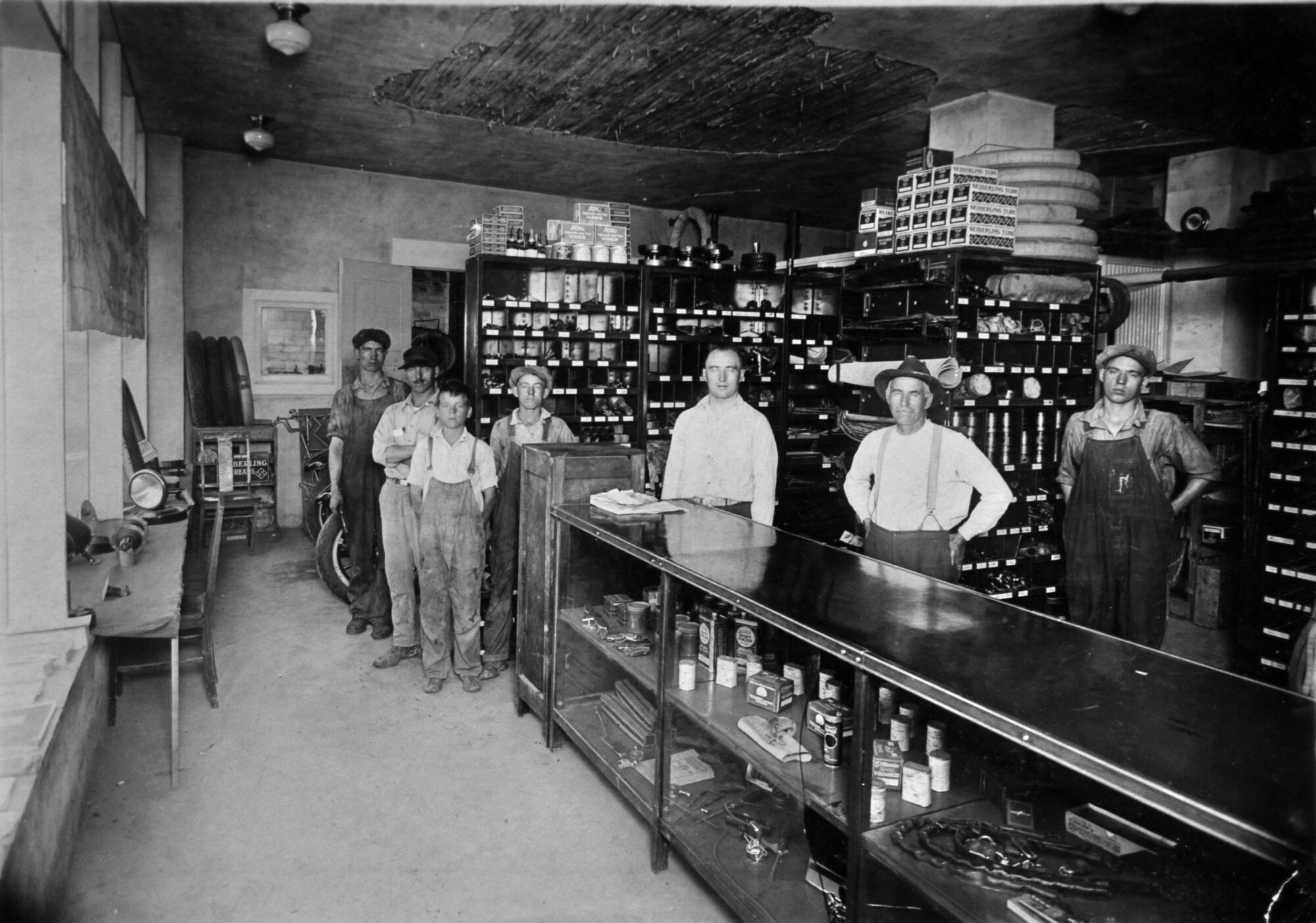
The Hein Family
Robert Albert Hein was born in 1868 Leipzig, Germany and emigrated to the U.S. in 1881. He married Anna (Kannenberg) Hein in 1891. Albert and Anna had 11 children: Carolina, Robert, Elsia, Elwin, Alvin, Viola, Lenhart, Ardell, Richard, Eldor, Otto.
All of the sons except Elwin, who died in infancy, worked at the Ford garage and dealership at one time or another.
Alfred and Anna Marie’s second child, Robert Hein, was a WW I veteran and was injured in a front line gas attack. He was the first post commander for the Mile High Veterans of Foreign Wars Post 1771 in Lafayette, formed in 1929.
Although Alvin “Al” Hein served with the volunteer fire department for a short time, and was a member of the Odd Fellows, the balance of the Hein family is not associated with the Ku Klux Klan dominated organizations from 1923 to 1937 — the town board, the school board, the Odd Fellows, or the Lions Club. To the contrary, during this period the Hein & Son Ford dealership recorded at the Boulder County Clerk’s office hundreds of chattel mortgages — car loans — which showed that the elder Albert Hein practiced racial equality in selling cars and extending credit to dozens of prominent Latino families.
Those individuals included Joe Jaramillo, one of eight coal miners killed in the 1936 Monarch coal mine explosion (and whose body was never recovered), D.H. Lueras, Domingo Espinosa, Frank Montez, Ray Abeyta, Manuel Munoz, Victor Trujillo, Charlie Martinez, Jose Munoz, Tony Cisneros, Francisca Torres, Crestino Gonzales, Nick Vigil, Lazaro Contreras, L.B. Garcia, Joe Sanchez, Felix Atencio, Julian Gallegos, Esequiel Cruz, Joe Tafoya, Lee Borrego, Paul Gallegos and Tony Guanella.
The Hein & Son Ford Dealership closed in about 1938, and the bulk of the family moved out of Lafayette. Albert Hein died in 1936, and Anna died in 1946.
Contractor O.C. Herdener
Longmont contractor Oscar C. Herdener built the Hein garage in 1924. From a multitude of news accounts, Herdener was a very busy man.
Born in 1882 in France, Herdener settled first in Denver in 1909 then Longmont where he worked as a carpenter at the Great Western Sugar Company. He launched the construction business O.C. Herdener & Sons in 1924.
From 1924 to 1929, Herdener built a dozen or more brick structures in Northern Colorado, including Hein & Son Ford Garage, Lafayette High School, Wellington High School, Domann Chevrolet in Longmont, and Weld County schools in Stone Ranch, Idaho Creek (Frederick) and Daley.
Herdener and his son also operated a lumber yard in Ovid. Oscar Herdener died in 1972.
Sources:
Lafayette Public Road Cultural Resource Survey, Bunyak Research Associates, 2011
Boulder County Clerk and Recorder
Lafayette Leader
Longmont Daily Times
Wellington Telephone Exchange Architectural Inventory Form OAHP1403, 1998