


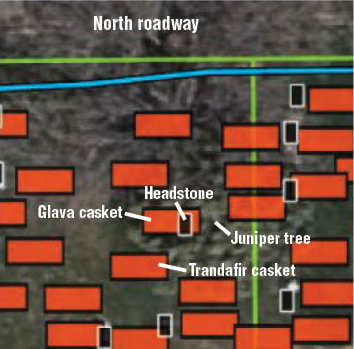
Without question, east Boulder County’s most publicized and long-standing legend is the Lafayette Vampire. He’s Glava the Vampire, historically known as Fodor the Vampire, and is said to be buried in the Potter’s Field section of the Lafayette, Colorado public cemetery at 111th and Baseline Road. His grave is located in the northwestern 1/8th of the cemetery, about 20 feet south of the paved road/exit from Lafayette’s Bob Burger Recreation Center.
The longtime legend boils down to this: A coal miner from Transylvania who was living in Lafayette died in 1918, was buried in the Lafayette Cemetery, and to make sure he didn’t rise from the grave, locals dig him up and drive a wood stake through his heart. From the stake grew a tree, which can be seen in the middle of his gravesite. Later enhancements to the legend include a rose bush near the grave marker sprouting from the vampire’s fingernails, and local children seeing a tall, thin man with long fingernails sitting on the grave. The headstone at the gravesite identifies two people, “Tranditor” and “Todor Glava,” both Romanians.
True to most legends, the vampire legend involving Teodor Glava (his actual name) has evolved and taken on narratives that are hard to believe. But by the late 2010s the legend had grown to cult status. Unfortunately, the “enhancements” to the legend make a person want to scream “C’mon folks, let’s at least get the ‘facts’ behind the legend correct. Never mind that vampires don’t exist.”
This legend — like all others — has been subject to the inventions and whims of the storytellers. The key words that are a part of this (and any) unfounded and fabricated tale of terror and mystery are: “My friend says…” “Some believe…” “Folks say…” “It is said…” “As lore has it…” “There are reports…” “The word was…” “Legend has it…” “Locals say….”
And the greatest irony is that “locals,” as in Lafayette residents who’d heard the legend for decades, scratch their heads about how this legend reached statewide, if not nationwide, cult status. Visitors from all over the country visit Teodor Glava’s gravesite all seasons of the year and leave mementos. Room keys, personal notes, sunglasses, costume jewelry, plastic and real flowers, toy vampires and coins. Lots of coins. (Coins left on headstones are a sign of respect. But respect for the person? Or respect for the vampire?)
The cult status of the Lafayette Vampire has grown to the point that dirt from Glava’s gravesite was offered up for auction on eBay. Really. No one knows if the dirt truly came from the gravesite, but city officials were notified of the eBay posting and eventually eBay took down the posting.
In reality, the story of Teodor Glava, a Romanian coal miner who immigrated to the U.S. around 1914, starts in his hometown of Lesnic, Romania, a mining community in the Transylvania Region of The Austro-Hungarian empire. Born in 1877, Teodor probably worked in the marble mines near his Lesnic residence. Hoping to find a better life in America, he left his wife Sofia and his daughter Victoria in Lesnic and landed first in Gary, West Virginia, then Canfield, Colorado west of Erie. (Estate records show that Glava worked in Lafayette but lived in Canfield. Technically the legend should be titled the “Canfield Vampire.”) Teodor died in 1918, probably in Canfield, a victim of the 1918 flu pandemic. He’s buried in the pauper’s section of the Lafayette Cemetery and his grave is marked by the primitive grave marker made of concrete, with lettering scratched with the pointed end of a brick trowel.
In explaining the vampire legend we also need to tell the story of the man buried next to Glava and sharing the grave marker: John Trandafir. He and Glava were fellow Romanian immigrants whose hometowns were a few hundred miles apart. Both worked at the Simpson coal mine in Lafayette and were most likely friends.

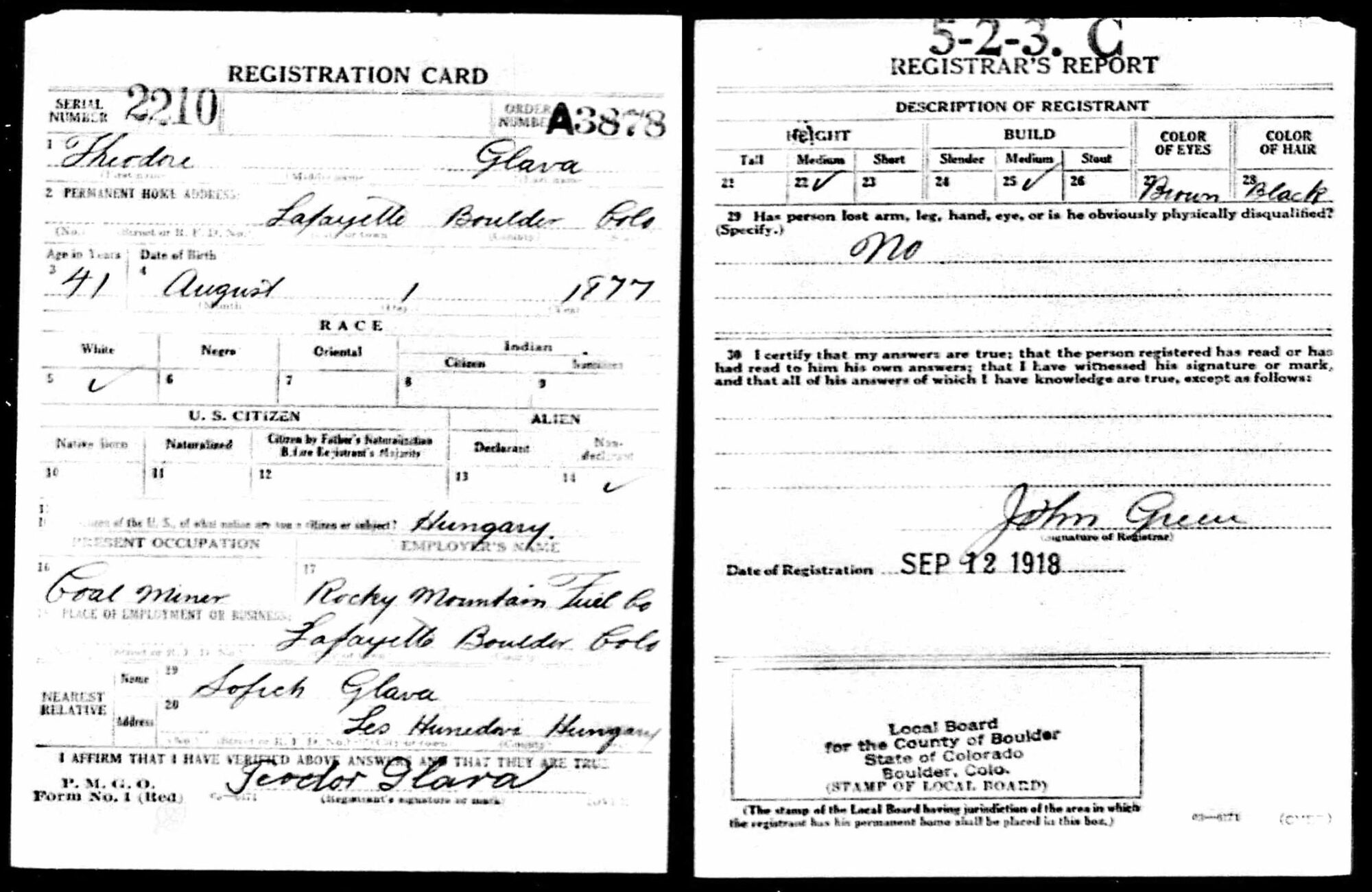
For consistency, the long-buried man brought into indissoluble local lore will be referred to here as “Teodor Glava” because that’s how he signed his name on his Sept. 12, 1918, military draft registration card. (There are many variations, possibly due to a language barrier, but that’s how he signed his name.) Variations of his name include:
Toader Glava — June 13, 1914 — Ellis Island immigration ledger, Romanian immigrant Petru Dinis lists Toader Glava as a cousin, address as Box 106, Gary, West Virginia
Tudor Glavor — May 17, 1918 — War bond purchase acknowledgement of Simpson Mine employees in Lafayette Leader
Theodore Glava — Sept. 12, 1918 — Name put on draft registration card by registrar John Green
Teodor Glava — Sept. 12, 1918 — Glava’s own signature on draft registration card
Theodore Glava — Dec. 6, 1918 — Death notice in Lafayette Leader
Toder Glaver — Dec. 12 1918 — Adjustment Day public notice in Lafayette Leader
Toder Glaver — June 4, 1920 — Final estate settlement notice in Lafayette Leader
Toder Glaver — All of his estate paperwork on file at the Colorado State Archives in Denver
Todor Glava — Lafayette Cemetery grave marker, but for some reason the “T” has been interpreted as an “F”, hence Fodor Glava
How the legend started
After two years of research and conversing with dozens of third- and fourth-generation Lafayette residents, the earliest mention of the vampire in the cemetery comes from Eleanor (Sanchez) Montour, who recalled that when she was a child in the late 1940s and early 1950s, her mom Alicia Sanchez occasionally warned her about the Transylvanian in the cemetery and that she should “get home before sundown so that the vampire doesn’t get you.” It was more of scare or behavior modification tactic Montour acknowledged in 2022, designed to keep her from misbehaving. And it worked.
All of the longtime residents interviewed, which covers Lafayette history starting in the 1940s, knew the vampire legend. The premise of a Transylvanian buried in the cemetery was followed by “he’s a vampire” in the 1950s, followed by the “tree must be the stake in his heart” in the 1960s, followed by the “rose bush is from his fingernails/hair” in the 1970s, followed by the mysterious man sitting on the headstone or walking in the cemetery in the 1990s, followed by a half-dozen other variations leading up to the publication date of this book.
None of the older residents I interviewed ever heard of or saw anything ghostly or ghoulish in the cemetery or at Teodor Glava’s gravesite. None of the former city employees interviewed for the book who worked in the cemetery experienced anything out of the ordinary. One former police chief — as reported in the newspaper — played up the legend, while another — interviewed by the author in 2023 — didn’t pay any attention to it.
No lifelong residents were able to pinpoint the exact time frame for the wood-stake-turning-into-a-tree part of the tale. That seems to have originated in the late 1950s, or early 1960s, when the Christopher Lee vampire movies started hitting the regional drive-in movie theaters. And none of the older residents could recall hearing (as children) the narrative of a mob of Lafayette residents digging up the grave and staking Glava.
For locals, the early legend was simple: A dude from Transylvania was buried in the cemetery, Transylvania is where vampires come from, and if you weren’t home by sunset, he would get you.
For decades, school kids did share scary cemetery stories on the school playground located about a block east of the cemetery. (The primary and secondary schools were side-by-side in two buildings on East Baseline Road until 1964 when Lafayette Elementary opened.) For years, the lighted high school football field was located in the former City Park, where the Bob Burger Recreation Center sits. The field was oriented north-south and the bleachers backed to the cemetery. To avoid the 15- or 25-cent entry price, kids often snuck into the games via the cemetery.
Nannette (Summers) Iatesta, another longtime resident who graduated from Lafayette High School in the late 1960s, said in a 2021 interview with the author that “The vampire was not on our radar screens. We loved darting in and out of the [Lafayette and Louisville] cemeteries but no one was really aware of Glava by name. The gravesite was practically covered over with wild yellow roses, which [years later] made the whole Transylvania/vampire aspect attractive.”
As a student at Centaurus High School in the 1970s, the author heard the vampire tale as well. Friends of the author who visited the gravesite at night in the 1970s and 1980s — to drink beer — swear that they didn’t experience anything more than a buzz from the beer.
The legend gets some PR
The first published account of a “Transylvanian vampire” is found in the October 31, 1987, Loveland Reporter-Herald, describing a gravesite in Lafayette Cemetery wherein “the word ‘Transylvania’ is scratched into the grave’s ruddy concrete headstone, and a scraggly pine tree shoots up through the plot’s center, an uncanny reminder of the wooden stake through the heart that doomed Dracula.
“ ‘ Several years ago we found a doll with a pin stuck through its heart that someone had placed on the grave,’ said former police chief Larry Stallcup, who said he learned of the grave site in high school [in the early 1950s]. ‘I read it was a voodoo tradition to prevent the buried person from rising from the grave.’ “
Edward D. “Jake” Wells, who at the time was a longtime Lafayette resident who placed headstones in the Lafayette Cemetery and at cemeteries along the Front Range, said in the story “Go up there at midnight and you’ll see the vampire sitting right on top of the stone.”
The story also paraphrases former Lafayette City Clerk Bev Smith, who said that a man named “Tudor Glava” purchased the gravesite in 1918, but also that there is “no record of who, in fact, is buried there.”
The article continues: “Longmont psychic Dori Spence recently visited the gravesite and said she sensed a protective curtain of energy surrounding the grave. ‘I definitely sense that a woman is buried there. It feels as if a man buried his housekeeper, or lover, thinking he would be buried here when he died. Later, he may have planted a rose bush before he went back to Transylvania. There is no evil associated with this person. Just the feeling that the grave is some sort of a loose end for both the man and the woman.’ “

John Trandafir and Teodor Glava buried side by side
Receipts from the Trandafir and Glava estates, found in state archives in Denver, show both men were embalmed and buried two days apart, Glava on Dec. 6 and Trandafir on Dec. 8. For Glava’s graveside services, undertaker R.R. Powell charged $10 for “opening and filling grave.” He invoices a similar amount two days later for Trandafir’s graveside services for “opening and filling grave.” Because of this, it’s not likely that the two were buried side by side in one grave site.
Burial receipts from the undertaker show that both men were buried in “plush caskets” which were wood caskets covered with fabric. Trandafir had a “plain cap lid casket” which is a casket where just the top half of the lid opens. Both caskets were then placed in their own wood “outside box,” a sort of grave liner, then placed in their own individual grave plot. Being buried in adjacent grave plots but two days apart, the undertaker’s hired hand would have had a tough time digging the second grave. The dirt surrounding Glava’s grave would have been unsettled and loose. Meaning that a wood partition was probably built to keep the dirt from Glava’s grave in place.

There are no available records from 1918 or 1919 indicating any special embalming or handling provisions in Colorado for someone who’d died from the flu, and Lafayette did not set aside any particular area of the cemetery for burial of flu victims (city records show they were dispersed throughout the cemetery). There was a statewide quarantine in place that banned indoor assemblage but no ban on people gathering outside.
The complexity and prominence of Trandafir’s services (a band was brought in from Denver), and a ceremony conducted under the auspices of the Orthodox Greek Church in Denver (following that church’s strict liturgical parameters) means there’s zero chance that church officials would have allowed Trandafir (buried in a casket Dec. 8) to be placed on top of the newly-interred Glava (buried in a casket Dec. 6); something akin to a mass burial. Especially since there was no shortage of cemetery gravesites during the 1918 flu pandemic, and no historical evidence showing that more than a few dozen people died and were buried in the cemetery in 1918. Additionally, the one entity in 1918 Colorado that could probably afford the $1.88 gravesite fee for a pauper would be the Orthodox Greek Church.

Tellingly, though, estate records show that both Trandafir and Glava weren’t paupers by any means and had thousands of dollars in savings. In 1918 dollars, Glava had $2,028 in cash, war bonds and savings certificates while Trandafir had $1,400 worth of war bonds and savings certificates ($41,000 and $27,500 in 2023 dollars respectively). Way more than enough to pay for a burial plot, casket and funeral. In fact, the total cost of Trandafir’s funeral was $420, or about $8,200 in 2023 dollars. Even though Lafayette was still under quarantine which forbade large indoor gatherings due to the influenza outbreak, Trandafir’s graveside service was big. It included the 20-plus-piece City Park Band from Denver (and prepaid tickets for their train fare), a hearse and modest casket, a canopy over the grave, muslin lining for the grave, car rental expenses for the pallbearers, an artificial flower wreath and the undertaker’s fitting of Trandafir for burial with a new, black broadcloth suit.
So Trandafir buried on top of Glava in a mass grave, or next to each other in one grave? No. Trandafir in a casket adjacent to Glava in a casket and both in their respective gravesites? Yes.

Teodor Glava facts:
• Married, medium height, medium build, brown eyes, black hair
• Born in 1877. Died Dec. 3, 1918, not Dec. 4, 1918, as the Lafayette Leader reported, and was buried Dec. 6.
• He worked at the Simpson coal mine.
• He wasn’t a resident of Lafayette, but rather lived in Canfield — a former coal mining camp west of Erie, Colorado — and rented a room for $1.12 per day from Mr. and Mrs. Nick Mack.
• His estate was valued at $2,000 in 1918, or about $40,000 in 2023 dollars. It was composed primarily of savings certificates, but he had $400 in war bonds.
• He was embalmed then buried in the Lafayette Cemetery which was owned by the Town of Lafayette (now the City of Lafayette).
• He was not destitute and not in need of government relief or public charity; meaning there was no economic reason to bury him in Potter’s Field.
• His best friend and the executor of the estate was John Long, a longtime supervisor at the mine.
• Including the modest $100 casket, his funeral cost $181.44 or about $2,000 in 2023 dollars. The funeral included a minister and singers which cost $8.00.
• His personal effects at time of death are described as not significant enough to inventory.
• He was sick for two weeks before he died and was cared for by Dr. William J. Rothwell, the company doctor for the Simpson mine.
• There is no evidence that Glava bought a grave plot at the cemetery prior to his death because it does not show up in the estate’s asset inventory. The executor or the undertaker purchased the grave site for his burial, although there’s scant records of the transaction.
• There are no records in city or cemetery archives showing the exact location of Glava’s grave, only a cryptic entry on a hand-drawn cemetery map showing that he was buried in Potter’s Field, which was roughly the north 1/8th of the Lafayette Cemetery.
• Estate records state that Teodor Glava “has no relatives in the State of Colo.” Estate records state that John Trandafir had any relatives living in the U.S.
• Glava’s wife was listed in estate records as Sophia Glaver; his daughter as Victoria Glaver Codrean. Both are listed as residing in Romania, and estate settlement funds were sent to a Romanian bank.

Grave marker made by George Lazar
There’s a primitive poured concrete memorial indicating Teodor Glava’s possible burial location. Words scratched into the drying concrete — with misspellings — are “+ 2 Romanion, Trandatir, Born in Rarhouth, Bocvina” on the top left and “+ Todor Glava. Born in Translvania” on the upper right, and a shared “AustroHungaria. Died December 1918” on the bottom. The scratchings in the concrete indicate the maker of the marker knew John Trandafir better than Teodor Glava. There’s more detail about Trandafir, including exact location of birth.
Determining the date of the grave marker is difficult. Generally, an average poured concrete sidewalk on a city block can last 70-80 years. But some sidewalks only last a few decades. The marker appears to be a sand and Portland cement combination — indicative of mortar for masonry — because there are no signs of aggregate or gravel.


Because the newspaper death notices state that neither Glava nor Trandafir had relatives living in the U.S., the Trandafir/Glava concrete marker was probably made by George Lazar, a friend. Lazar was a fellow immigrant from Bukovina, Romania, a region of Romania that’s contiguous with but northeast of Transylvania. Lazar bought the gravesite, bought flowers and candles for the gravesite services, and arranged for the music for the ceremony. He billed Trandafir’s estate $37.50 for those items. Research indicates that in 1918 Lazar worked at a Rocky Mountain Fuel Company mine in Morley, Colorado. In 1942, Lazar filled out a WWII draft registration card and listed his address as Frederick, Colorado. Lazar’s writing on the draft card — in block letters — matches the lettering on the Trandafir/Glava headstone. If Lazar did create the grave marker, he would have done it in the correct location because he was in attendance at the graveside services.
The “Rarhouti, Bocvina” description on the marker is Părhăuți, Romania which is in the Bukovina (also Bucovina) region of Romania. Trandafir’s 1917 draft card lists his place of birth as “Pirvuct Justed Lucsava, Austria.” (Trying to figure out the contemporary equivalent was futile, although “Justed” means “county.”) Estate records show that John Trandafir’s mom, Elisabeta Trandafir and his four brothers, names unknown, lived in Părhăuți, but the documents spell it as Perhaut, Perhautz and Perhauti.
The marker’s alignment with surrounding headstones suggests that the vertical line in the grave marker sits atop the dividing line of the grave spaces — Glava in the north 4’ x 9’ grave space and Trandafir in the south 4’ x 9’ grave space. A 2025 ground penetrating radar study determined the marker sits over Glava’s knees and nowhere close to John Trandafir.
Spanish Flu deaths in 1918 had caused a shortage of caskets in parts of the U.S., but not in Lafayette. According to local undertaker R.R. Powell’s 1918 invoices, both Glava and Trandafir were buried in caskets, Glava first on Dec. 6 then Trandafir on Dec. 8. Powell’s invoices also show that Glava’s casket was encased in “an outside box” and indicate that separate graves were dug for each and then filled in, Glava first, then Trandafir two days later. (Trandafir’s funeral invoices also show the use of an “outside box” but don’t say whether it was used for transporting him from Denver or for use in the burial.) Both men were in the height and weight range to fit an average 24- to 28-inch wide casket. (They were both probably reasonably fit — they shoveled coal all day after all.) This leaves a roughly 2-foot margin between the caskets, which is where — in the margin — the grave marker is centered. The juniper tree is growing about two feet east of Glava’s feet.
So the stake in the heart narrative is more like a stake in the toe. But even that’s a stretch.
(This post was updated with new information 6/12/2026 and is condensed from the book “Myths and Legends of Lafayette and Louisville” by Doug Conarroe, published in 2023 and containing many, many more facts about the vampire legend. The book as available in Lafayette, Colo. at the Lafayette History Museum and the Read Queen Bookstore. Buy Ghosts and Legends of Lafayette and Louisville online from Arcadia Publishing. )